Cleaning and care for sheetfed offset printing
VARN Calcium Deglazer
Removal of calcium deposits from rollers and blankets.
What should you look out for?
After use, rinse thoroughly with water according to the card. Then use the appropriate wash.

VARN cleaning includes agents for removing deposits, cleaning rubber and caring for printing plates. Choose the preparation according to the place of contamination and the surface material. Plate or water circulation cleaner does not replace roller cleaner.
Check also the full range of VARN chemicals and general offer of WIT printing chemicals.
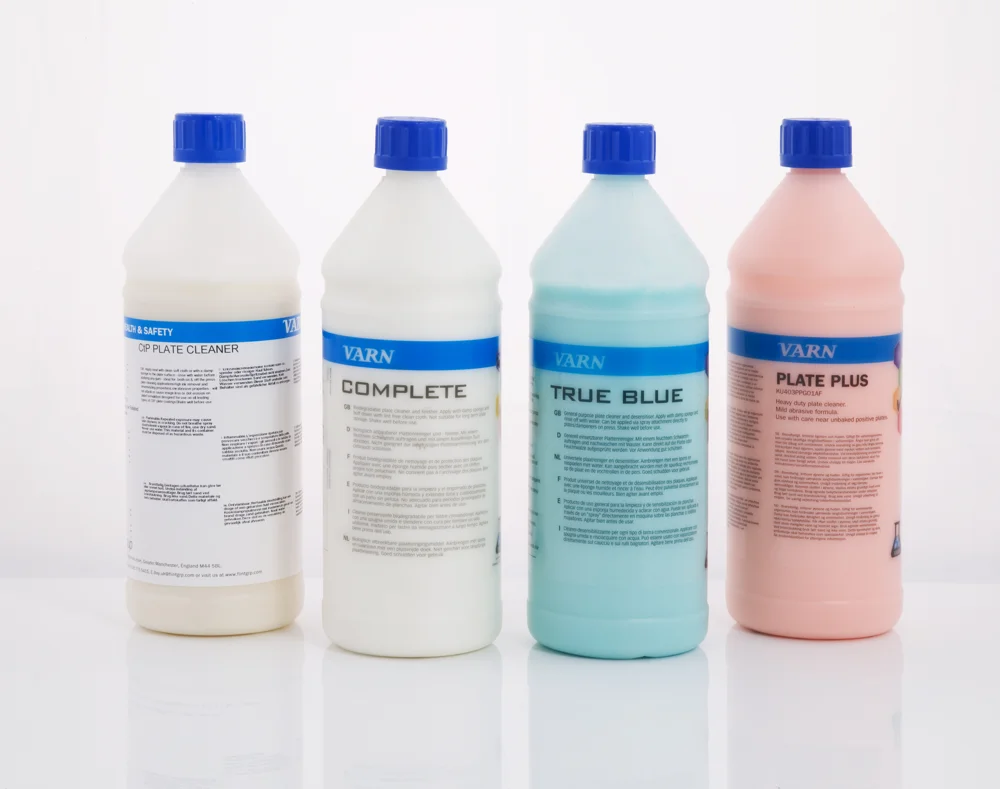
First, determine whether you are removing ink, calcium, rubber glazing or board dirt. Then check the surface material. The machine frame preparation does not replace the dressing agent.
Separate daily washing from periodic washing. For routine ink removal, choose VARN washes. Use the intensive care product according to the contact time and method of removal from the card.
Compare applications and product selection conditions below. Download available technical data sheets (PDF, ENG). If you need a safety data sheet or information about another variant, please write to us.
Cleaning and care for sheetfed offset printing
Removal of calcium deposits from rollers and blankets.
After use, rinse thoroughly with water according to the card. Then use the appropriate wash.
Cleaning and care for sheetfed offset printing
Deep cleaning of rollers and blankets, also EPDM.
After treatment, remove any residue with an appropriate wash. Stick to the time on the card.
Cleaning and care for sheetfed offset printing
Cleaning and care of rollers and blankets.
Do not use on EPDM rolls or unfired positive plates.
Cleaning and care for sheetfed offset printing
Removing glazing and stubborn residues from rubber surfaces.
Do not exceed one hour on EPDM rollers. Remove the preparation before printing.
Cleaning and care for sheetfed offset printing
Cleaning of NBR and NBR/PVC dampening rollers in conventional printing.
Do not use on EPDM. Follow the rules for working with flammable preparations.
Cleaning and care for sheetfed offset printing
Cleaning EPDM and NBR/PVC dampening rollers in UV printing.
Do not use near UV lamps. Take into account the flammability of the preparation and the machine instructions.
Cleaning and care for sheetfed offset printing
Intensive washing of blankets; confirm additional uses in the card.
Do not use on EPDM and polyurethane rollers. It does not replace routine ink unit wash.
Cleaning and care for sheetfed offset printing
Cleaning, desensitization and protection of printing plates before storage.
Select for a specific printing plate. Do not force drying with a fan or heat.
Cleaning and care for sheetfed offset printing
Intensive cleaning of printing plates after conventional, UV or metallic inks.
Contains a gentle abrasive ingredient. Frequent heavy cleaning may weaken the image of an unfired positive plate.
Cleaning and care for sheetfed offset printing
Cleaning and desensitization of printing plates.
Check board compatibility and recommended application method in the current card.
Cleaning and care for sheetfed offset printing
Non-abrasive cleaning of aluminum CtP plates indicated in the card.
This is a plate surface treatment, not an plate processor bath treatment.
Cleaning and care for sheetfed offset printing
Cleaning the tanks and the dampening solution circuit.
After cleaning, rinse the installation and prepare a fresh solution. Don’t leave it as a buffer.
Cleaning and care for sheetfed offset printing
Degreasing machine frames, covers and work surfaces.
Check the surface’s resistance to the preparation. It does not replace rubber ink wash.
Check compatibility with NBR, NBR/PVC and EPDM separately. Do not transfer the recommendations of one remedy to another. Removing deposits can improve surface performance. Chemicals cannot mechanically repair a worn roller or blanket.
After cleaning the dampening system, perform the required flushing. Prepare a new solution with the appropriate one VARN buffer. When dealing with plates, pay attention to the abrasive ingredients and image resistance.
No. Strong formulation may not be compatible with rubber or printing plate. Match the cleaner to the deposit and surface. Do not simply extend an unsuitable product’s contact time.
Describe the dirt, surface, type of rubber or board and the preparation used so far. WIT will confirm the correct variant, packaging, availability and pricing. We set the price for a specific product and quantity.