

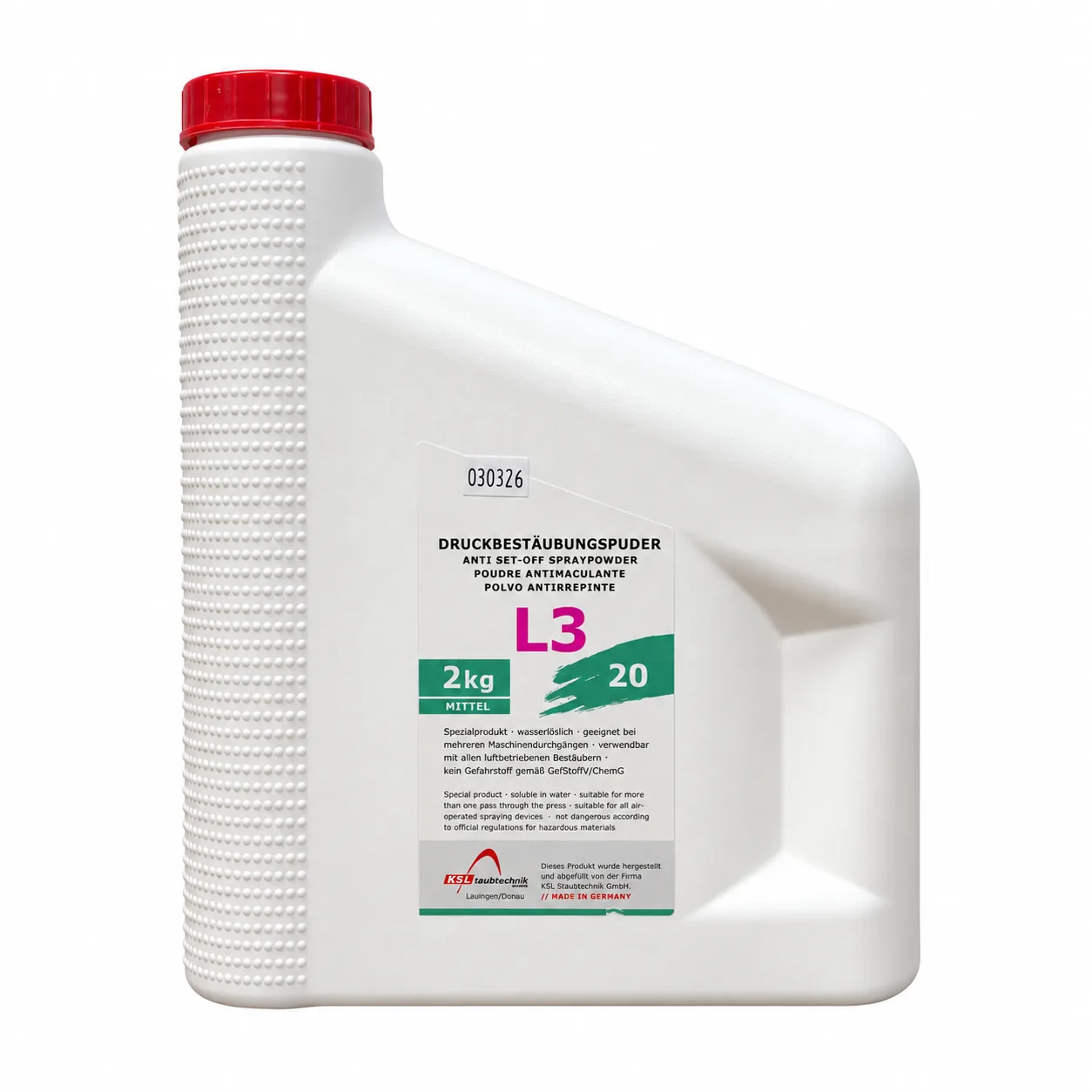
KSL L3 20 anti-set-off powder separates freshly printed sheets and reduces ink set-off in the stack. Choose it especially for sheets making multiple press passes.
Water solubility helps reduce powder build-up on the blanket during the next pass. This matters for multiple-pass jobs and subsequent finishing.
How does sugar-based powder help on the next press pass?
- Less powder build-up on the blanket: residual moisture dissolves particles, limiting build-up compared with insoluble powder.
- Smoother finishing processes: soluble powder suits jobs intended for lamination or coating.
- Separation of fresh prints: soft, rounded particles create separation between sheets.
- Stability under standard humidity conditions: The powder does not become sticky due to normal ambient humidity.
KSL L3 20: which paper suits this grade?
For gloss-coated paper, grade 20 is a starting point up to 250 g/m². For matt-coated or uncoated paper, start with the 200 g/m² recommendation.
| Glossy coated paper | Indicative range: up to 250 g/m² |
|---|---|
| Matte and uncoated paper with a compact surface | Indicative range: up to 200 g/m² |
These recommendations guide initial trials, not every print result. Also consider substrate surface, ink film and planned finishing.
Parameters for the selected variant
| Series and grade | L3 / 20 |
|---|---|
| Base | Natural sugar derivative |
| Grain surface | Soft, rounded grains |
| Solubility | Water-soluble |
| Package contents | 2 kg |
How to adjust powdering when changing jobs
- First check powder-system flow and spray uniformity according to the press manual.
- Select the grain grade based on the substrate, the presence of varnish, and any subsequent finishing processes.
- Run a trial, then check ink set-off and sheet separation in the stack.
- Set the minimum effective amount of powder and re-evaluate the result after adjusting the parameters.
With L3, regularly check the powder system and nozzles for deposits. Particle abrasion can cause build-up despite water solubility.
Questions for the press operator before selecting a powder
When should you choose L3 instead of the starch-based S5?
Consider L3 when powder builds up on the blanket during repeated passes. Residual moisture dissolves the grains and limits deposits.
Is L3 suitable for use before lamination (foiling)?
Yes, the series also suits work intended for lamination and coating. Check the print surface before finishing. An additional wet de-powdering pass can help.
Does water solubility mean the powder will clump due to atmospheric humidity?
Not under normal humidity. Nevertheless, store it dry in tightly closed packaging, away from water.
Compare Printing powders and available particle size grades. Select the series based on the printing technology used for the job, then choose the specific variant according to the substrate.
 Varn Defoamer - fountain solution defoamer, 1 l
 Varn Orange Scrub - hand-cleaning paste, 3 kg
 Varn Plate Plus - offset plate cleaner, 1 l
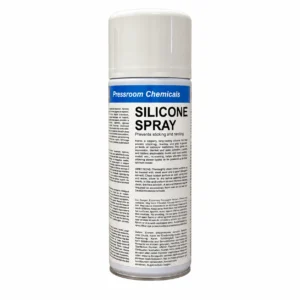 Varn Silicone Spray - silicone spray, 400 ml
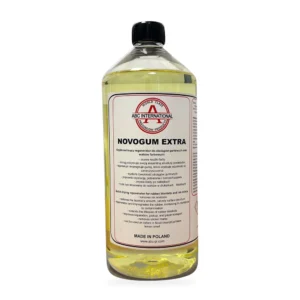 ABC Novogum Extra - roller and blanket rejuvenator, 1 l
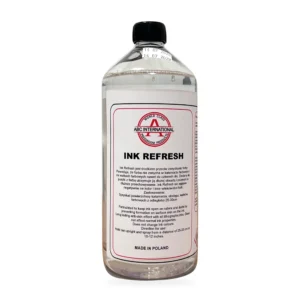 ABC Ink Refresh - anti-skin ink treatment, 1 l

Reviews
There are no reviews yet.